Introduction
Education in India is changing rapidly. Students no longer need to depend only on classroom lessons, printed textbooks or traditional coaching centres to explore new subjects. With internet access, smartphones and digital learning tools, they can revise school lessons, prepare for competitive examinations, practise quizzes and develop new skills from almost anywhere.
Today, the best Indian education websites serve different learning needs. Some offer live classes and structured courses, while others provide free educational resources, digital libraries, exam updates or interactive quizzes. The right platform depends on a student's age, academic goals, preferred language and available budget.
For example, a CBSE student revising mathematics may benefit from curriculum-aligned lessons, while a UPSC aspirant may need current affairs and examination resources. A college student might prefer a digital library, and someone who wants to test general knowledge could find quiz-based learning more engaging.
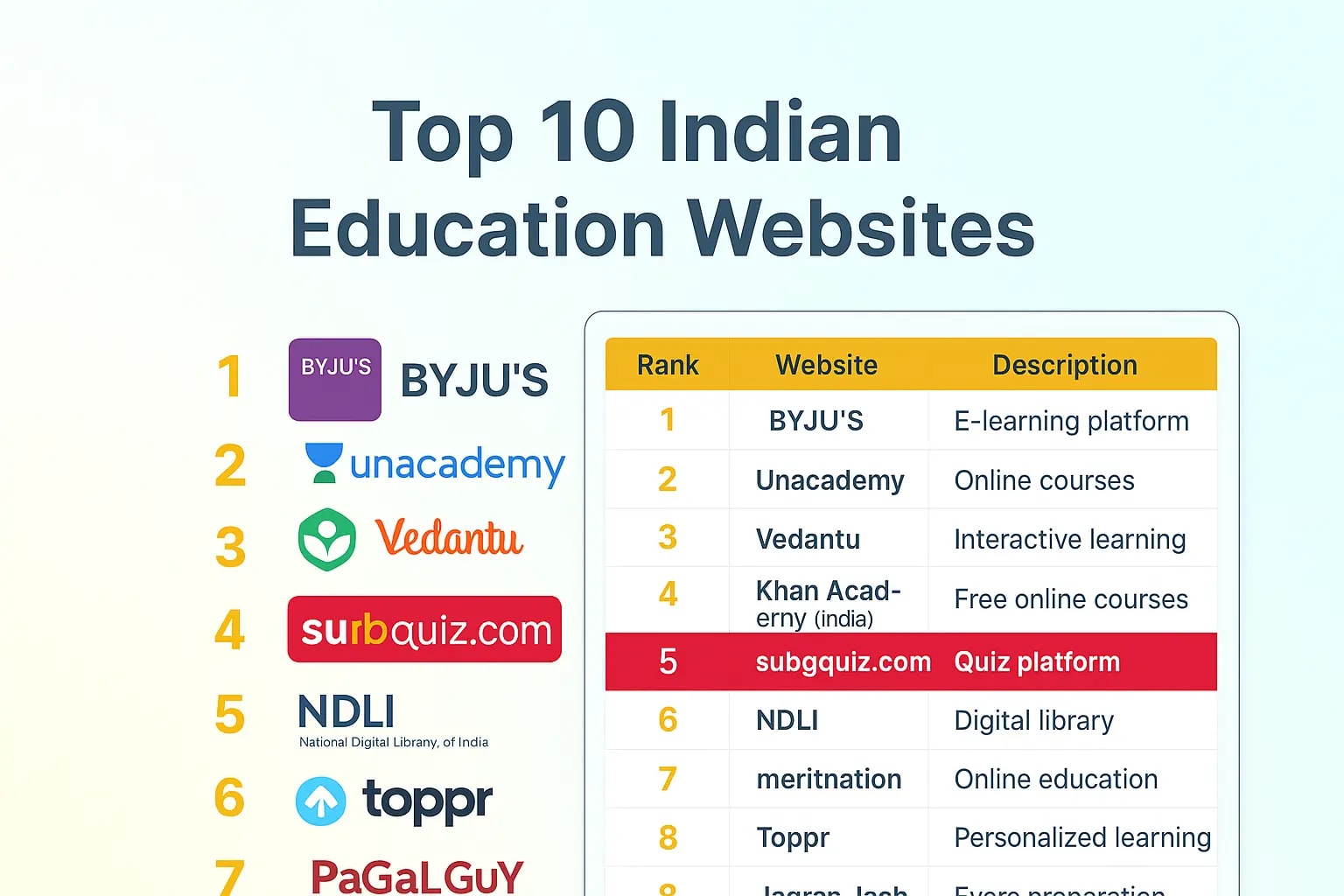
This guide explores ten education websites and learning platforms that students in India can consider in 2026. The list includes established learning brands, public educational resources and specialist platforms. It is a practical selection rather than a strict ranking, because no single website is best for every learner.
Important: Course availability, pricing, features and platform operations can change. Check the official website before purchasing a subscription or relying on a particular service.

Quick Comparison of the Top 10 Indian Education Websites
Website | Main learning purpose | Best suited for |
|---|---|---|
Structured digital learning programmes | School students and selected exam aspirants | |
Live classes, courses and exam preparation | Competitive exam aspirants | |
Online tutoring and school learning | Students seeking teacher-led support | |
Free lessons aligned with the Indian curriculum | School students, parents and teachers | |
Interactive quizzes and knowledge practice | Learners who enjoy self-assessment | |
Educational, scholarly and research resources | School, college and research learners | |
School study materials and academic support | School students, subject to current availability | |
School learning and exam-preparation resources | Students checking legacy learning resources | |
Exam information, current affairs and study content | Government exam aspirants and students | |
Education information and student communities | MBA aspirants and higher-education applicants |
The table is a starting point, not a guarantee that every platform offers the same services it did in the past. In particular, confirm the current status and accessibility of older platforms such as Meritnation and Toppr before depending on them.
Top 10 Indian Education Websites for Students
1. BYJU'S — Digital Learning for School Students
Website: https://byjus.com/
BYJU'S is a recognised name in India's educational technology sector. Its learning model has focused on structured lessons, visual explanations, practice activities and personalised learning programmes.
For school students, visual explanations can make abstract concepts easier to understand. A student learning science, for instance, may benefit from seeing a concept explained through illustrations before attempting textbook questions.
BYJU'S has also promoted programmes for selected competitive examinations. However, the availability of specific courses, teachers, subscriptions and support can change, so learners should review the latest details directly on its website.
Best for: Students and parents exploring structured digital learning programmes.
What to check: Course availability for the required class, total fees, trial options, refund terms and the quality of doubt-solving support.
2. Unacademy — Online Classes and Competitive Exam Preparation
Website: https://unacademy.com/
Unacademy offers online learning programmes across multiple examination categories. Its website lists preparation options for goals such as UPSC, IIT JEE, NEET, banking examinations, SSC and MBA entrance tests.
The platform's learning experience can include live classes, recorded lessons, practice questions, study materials and opportunities to interact with educators. These features can help students follow a study schedule without travelling to a physical coaching centre.
For competitive exam aspirants, the most important factor is whether a course follows the latest syllabus and examination pattern. Students should also evaluate an educator's teaching style, the course duration and the availability of practice tests before subscribing.
Best for: Learners who prefer structured online preparation for competitive examinations.
What to check: Current course offerings, subscription conditions, educator credentials and included study resources.
3. Vedantu — Teacher-Led Online Learning
Website: https://www.vedantu.com/
Vedantu focuses on online tutoring and teacher-led learning experiences. Live teaching can help students ask questions, receive explanations and work through difficult concepts with guidance.
This approach may be useful when watching a recorded video is not enough. For example, a student struggling with algebra can benefit from seeing a problem solved step by step and asking follow-up questions.
When comparing online tutoring services, parents should look beyond promotional claims. Class size, teaching quality, lesson frequency, individual attention and the total cost of a programme all affect the learning experience.
Best for: Students who want guided lessons and opportunities to interact with teachers.
What to check: Whether the relevant course is currently offered, class format, teacher availability and fees.
4. Khan Academy India — Free Curriculum-Aligned Learning
Website: https://india.khanacademy.org/
Khan Academy India is a useful option for students looking for free academic learning resources. Its official website describes free content for Grades 1–12 aligned with the Indian curriculum, including mathematics and other school subjects.
The platform is particularly helpful for revising concepts at an individual pace. Students can revisit earlier lessons, practise skills and strengthen foundational knowledge before moving to more difficult topics.
Khan Academy India also provides content in several languages, including English, Hindi and Hinglish, alongside additional Indian languages. This can make its resources accessible to learners with different language preferences.
Although free digital lessons can supplement classroom teaching, students should still check that a lesson matches their specific board, class and syllabus.
Best for: School students who want to revise concepts without paying for a standard subscription.
What to check: Curriculum alignment, language options and whether the topic matches the student's current syllabus.
5. SUBG QUIZ — Interactive Quizzes and Knowledge Practice
Website: https://subgquiz.com/
SUBG QUIZ is a quiz-focused learning platform designed around practice, progression and knowledge testing. Its website describes quizzes across categories such as general knowledge, science, mathematics, reasoning, aptitude, English and current affairs.
Interactive quizzes offer a different way to study. Instead of only reading notes, learners must recall information, choose answers and review their understanding. This can help them identify topics that require additional revision.
The platform also describes features such as levels, performance tracking and certificates associated with milestones. Students should review the applicable conditions to understand which features are free and which may require tokens or paid options.
For effective learning, use quiz results as feedback rather than as a complete measure of academic ability. A high score in a general knowledge quiz, for example, does not automatically demonstrate readiness for a formal competitive examination.
Best for: Learners who enjoy quizzes, general knowledge practice and self-assessment.
What to check: Question explanations, topic coverage, scoring rules, certificate conditions and any paid features.
6. National Digital Library of India (NDLI) — A Digital Learning Resource Library
Website: https://ndl.iitkgp.ac.in/
The National Digital Library of India is a digital repository supported by the Ministry of Education, Government of India, and developed by the Indian Institute of Technology Kharagpur. It brings educational and scholarly resources together through a searchable platform.
Unlike a conventional coaching website, NDLI is designed to help learners discover resources across educational levels and subjects. Students can explore materials relevant to school education, higher education and research.
This makes NDLI particularly useful when preparing an assignment, researching a topic or looking for supplementary academic resources. It can also help college students and researchers discover material from different institutions and content providers.
Not every resource should be assumed to be freely downloadable or available under identical conditions. Check the access terms for individual items, and assess the original source's authority and relevance before citing a resource in academic work.
Best for: School and college students, teachers, researchers and lifelong learners looking for educational resources.
What to check: The resource's original publisher, access conditions, relevance and publication date.
7. Meritnation — A School Learning Resource to Check
Website: https://www.meritnation.com/
Meritnation has historically been associated with school-level study materials and academic support for students in India. Its name has been linked to resources for school subjects, board examinations, practice questions and revision.
For students and parents considering this platform, the key step is to confirm which services are currently available. A website's historic reputation does not necessarily mean that every course, feature or study resource is still active or maintained.
If suitable resources are accessible, compare them with the student's prescribed textbook, school assignments and current syllabus. Do not purchase a course until its availability, fees and support arrangements are clear.
Best for: Students investigating additional school study resources, subject to current service availability.
What to check: Whether the required class and subject are supported, whether the material is updated, and whether customer support is available.
9. Jagran Josh — Exam Updates, Current Affairs and Study Content
Website: https://www.jagranjosh.com/
Jagran Josh is an education and career information portal that publishes content for students, job seekers and competitive exam aspirants. Its resources include examination-related information, study material and current affairs content.
This type of website is especially useful when learners need to understand an examination's schedule, eligibility criteria, syllabus or preparation requirements. Current affairs resources may also support general knowledge preparation, depending on the examination.
Students should distinguish editorial study content from official notifications. For registration dates, application fees, eligibility and examination rules, always verify the details on the relevant examination authority's official website.
Best for: Students seeking exam-related information, educational updates and current affairs material.
What to check: Publication dates, cited sources and the latest official examination notifications.
10. PaGaLGuY — Higher Education and MBA Communities
Website: https://www.pagalguy.com/
PaGaLGuY is known for education-related discussions, particularly around MBA admissions, entrance examinations and business schools. Its website includes information about colleges, admissions and education topics, alongside community-oriented content.
For MBA aspirants, student discussions can provide additional perspectives on preparation, college applications and the admissions experience. However, forum discussions represent individual experiences and opinions rather than guaranteed facts.
Before making an important decision, compare community advice with official college websites, published admission criteria, fee details and recognised accreditation information.
Best for: MBA aspirants and students researching higher education options.
What to check: The date of each discussion, the credibility of contributors and official confirmation of admission requirements.

Best Free Education Websites in India
Students do not always need a paid course to start learning online. Several platforms provide free resources, although the scope of free access differs.
Here are three useful starting points:
Khan Academy India: Offers free curriculum-aligned learning content for Grades 1–12.
National Digital Library of India: Helps users discover educational and scholarly resources; access conditions can vary by item.
DIKSHA: A national digital education platform with learning resources for students and teachers. Explore it at diksha.gov.in.
DIKSHA supports educational content associated with Indian school curricula and provides resources in multiple languages. Some content can be accessed through textbook QR codes, making it a useful companion to classroom learning.
Students should distinguish between a website being free to access and every course, certificate or resource being free. Check individual terms before enrolling or paying.
For additional resources, explore ZaidApp's guides on SEO basics for beginners and learning web development in 2026.
How to Choose the Right Education Website
The right education website is the one that matches your learning goal, not necessarily the one with the biggest brand name.
1. Check curriculum alignment
School students should confirm whether lessons match CBSE, CISCE/ICSE or their relevant state board. Competitive exam aspirants should check the latest official syllabus and examination pattern.
2. Evaluate teaching quality
Look for clear explanations, accurate information, worked examples and opportunities to practise. If possible, sample a lesson before paying for a course.
3. Compare free and paid features
Review the full subscription price, renewal terms, refund policy and features included. A free resource may be sufficient for revision, while structured tutoring may be more appropriate for students who need additional support.
4. Look for useful assessments
Practice questions, mock tests and feedback can help students identify weak areas. Explanations of incorrect answers are often more useful than a score alone.
5. Consider language and accessibility
A student may learn more comfortably in Hindi, English or another supported language. Check mobile usability, video quality, captions and accessibility features, especially if internet access is limited.
6. Verify credibility
For academic facts, check authoritative sources and the date of publication. For exam rules, use the official examination authority. For paid courses, read the terms and investigate the provider before sharing payment information.
Trends in India's Online Education Sector
Digital learning continues to offer new ways for students and teachers to access educational resources. Several trends are shaping the experience.
Personalised learning: Platforms can use practice results and learner activity to recommend topics for revision. Recommendations should support learning rather than replace a teacher's judgement.
AI-assisted study: AI tools can help explain concepts, generate practice questions and organise revision. Students should verify important facts, especially in science, mathematics and examination preparation.
Regional-language education: Multilingual lessons can make learning more accessible to students who are not comfortable studying every subject in English.
Microlearning and interactive quizzes: Short lessons and frequent practice sessions can fit into busy schedules. Their effectiveness depends on the accuracy of the content and the learner's consistency.
Digital libraries and open resources: Public educational initiatives can help learners discover resources without relying exclusively on commercial subscriptions.

Challenges of Online Learning
Online education offers flexibility, but it does not remove every barrier to learning.
Internet and device access: Unreliable connectivity, limited data and shared devices can make consistent study difficult.
Distractions: Notifications and unrelated content can interrupt learning. A fixed study schedule and a distraction-free environment can help.
Content quality: Not every online explanation is accurate or up to date. Compare important information with textbooks, teachers and authoritative references.
Subscription costs: Some platforms offer only limited free content. Families should review the total cost before committing to a course.
Limited personal interaction: Recorded lessons may not provide immediate help when a student is confused. Teacher support or study groups can fill this gap.
The most practical approach is to use online resources as part of a broader learning routine that includes textbooks, revision, practice and guidance from qualified teachers.
Conclusion
The best Indian education websites give students more ways to learn, revise and explore new subjects. From free lessons on Khan Academy India to the resource collections of NDLI, exam information from Jagran Josh and interactive practice on SUBG QUIZ, different platforms serve different purposes.
Before choosing a website, identify your learning goal, check the quality and relevance of its content, compare costs and verify current course availability. Use official sources for important examination information and treat online learning as a complement to regular study rather than a guaranteed shortcut to success.
With a clear goal and a consistent study routine, students can use digital education resources to strengthen their understanding, practise important skills and make better-informed learning decisions.


Comments
No comments yet. Be the first to comment!