Customers expect businesses to provide quick responses, relevant recommendations and convenient digital experiences. When a company takes too long to answer a question or makes it difficult to find information, customers may look for another provider.
Artificial intelligence (AI) is helping businesses improve these interactions by automating routine tasks, analysing customer requests and delivering more relevant information.
AI in customer experience refers to using AI technologies to improve how customers interact with a business across websites, mobile applications, customer support, sales and other communication channels.
For example, an AI-powered chatbot can answer common questions at any time, while a recommendation system can suggest products based on a customer's interests. AI can also help support teams summarise conversations, organise enquiries and identify recurring customer problems.
However, AI is not a replacement for every human interaction. Businesses need accurate information, suitable privacy safeguards and clear ways for customers to contact a person when necessary.
This guide explains how AI improves customer experience, explores practical applications across industries and outlines how businesses can adopt AI responsibly.
What Is AI in Customer Experience?
AI in customer experience involves using technologies such as machine learning, natural language processing and generative AI to support customer interactions.
These technologies can help systems interpret questions, identify patterns, generate responses and recommend relevant actions.
Common examples include:
AI chatbots that answer frequently asked questions.
Recommendation systems that suggest relevant products or services.
Automated systems that categorise and route customer enquiries.
AI tools that summarise support conversations.
Virtual assistants that help users navigate digital services.
Analytics tools that identify recurring customer concerns.
AI capabilities vary between products. A basic chatbot that follows predefined rules is different from a generative AI assistant that interprets questions and produces responses from approved information.
The goal is to make customer interactions more useful, consistent and efficient—not to add automation where it creates unnecessary complexity.
How AI Improves Customer Experience
1. Faster Customer Support
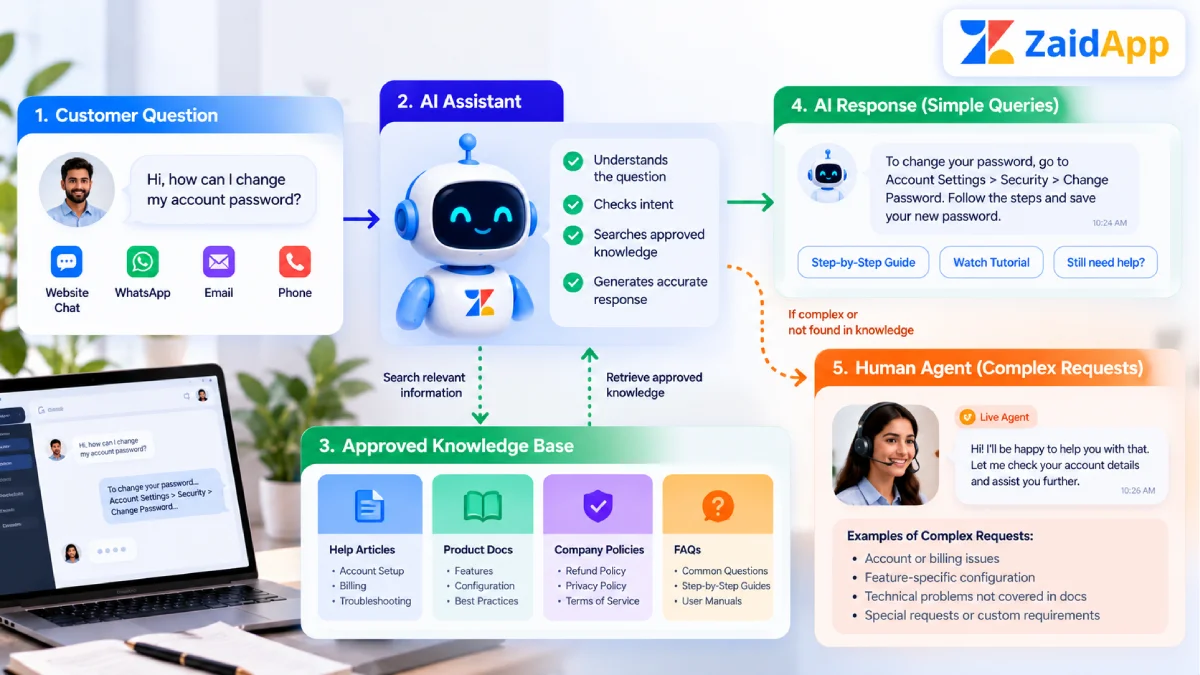
AI-powered assistants can respond to common questions without requiring a support agent to answer every request manually.
For example, a customer visiting a service website may ask about opening hours, service features, payment methods or the next step in a booking process.
If the assistant has access to accurate, approved information, it can provide a useful response immediately. More complicated requests can be directed to a human representative.
Businesses should regularly review chatbot answers and ensure that customers can reach a person when the AI cannot resolve a problem.
2. Personalised Recommendations
AI systems can analyse relevant information, such as a customer's selected preferences or previous interactions, to recommend suitable products, services or content.
An ecommerce website might suggest related products, while a travel platform could present destinations based on a traveller's stated budget and interests.
Personalisation should be relevant and transparent. Businesses should respect customer privacy, comply with applicable data protection requirements and avoid making intrusive recommendations based on sensitive information.
3. 24/7 Self-Service
Customers do not always contact a business during office hours. AI assistants and automated knowledge systems can help users find information outside normal working times.
A customer might check a product feature, learn how to use a service or find instructions for a common issue.
Self-service works best when information is accurate, easy to navigate and regularly updated. If an answer is uncertain, the system should explain its limitations instead of inventing information.
4. Better Understanding of Customer Needs
AI can help analyse customer feedback, support tickets and survey responses to identify recurring questions or frustrations.
For example, if customers repeatedly ask how to complete a particular form, a business may discover that its instructions are unclear.
These insights can help teams improve website content, product design and support processes. AI-generated analysis should be reviewed before important business decisions are made.
5. More Efficient Customer Service Teams
AI can assist employees by summarising conversations, categorising enquiries, drafting responses and retrieving relevant information.
This can reduce repetitive administrative work and allow support teams to focus on complex customer problems.
However, businesses should monitor response quality and customer outcomes. Faster processing is not useful if answers become less accurate or customers need to contact support repeatedly.
6. Consistent Communication Across Channels
Customers may interact with a business through its website, email, messaging platforms and support portals.
AI-assisted systems can help teams organise information and maintain more consistent responses across these channels.
Successful implementation depends on reliable integrations, clear data permissions and accurate business information. Businesses should avoid giving AI access to systems or customer records it does not need.
7. Proactive Customer Assistance
AI can help identify patterns that may indicate a customer needs assistance.
For example, a support platform might flag repeated failed attempts to complete a process, allowing the team to investigate the problem.
Proactive assistance should be based on appropriate signals and respectful communication. Automated alerts should not make unsupported assumptions about a customer's intentions or circumstances.

AI Applications Across Different Industries
AI customer experience solutions can serve different purposes depending on the industry and customer journey.
Ecommerce and Retail
Retail businesses can use recommendation systems, conversational assistants and automated order-support tools to help customers find products and resolve common questions.
AI can also assist teams in analysing product feedback and identifying recurring customer concerns.
Recommendations should remain relevant, and customers should receive accurate information about pricing, availability and delivery.
Healthcare
Healthcare organisations may use AI to help patients navigate appointment information, find general service details or manage administrative enquiries.
These applications require particular care because health information is sensitive. AI tools should not be treated as a substitute for qualified clinical judgement, and access to patient data must follow applicable privacy and security requirements.
Banking and Financial Services
Financial institutions can use AI to assist with common service questions, organise support requests and identify potentially unusual activity.
Financial decisions and sensitive account actions require suitable verification, oversight and security controls. AI-generated answers should not replace formal financial disclosures or authorised professional advice.
Travel and Hospitality
Travel companies can use AI to help customers explore destinations, compare suitable options and organise itinerary information.
Hotels and travel agencies may also use conversational tools to answer questions about services, bookings and policies.
For travel businesses, accurate availability, pricing and booking information are essential. AI should not promise reservations or services without reliable confirmation.
Explore ZaidApp's travel website development services to learn more about building digital experiences for travel agencies and tour operators.
Education
Educational platforms can use AI to answer common navigation questions, recommend learning resources and help students find relevant lessons.
Learning applications should clearly distinguish general AI-generated explanations from verified course content. Students should be encouraged to check important facts and consult teachers when needed.
Software and Technology Companies
Software companies can use AI assistants to guide users through documentation, explain product features and help customers troubleshoot common problems.
An assistant connected to an approved knowledge base may help users find relevant instructions more quickly. Complex technical issues should be escalated when the assistant cannot provide a reliable solution.
Benefits of AI for Businesses
When implemented carefully, AI can support several business objectives.
Reduced repetitive work: Automated handling of routine requests can give employees more time for complex tasks.
Faster responses: AI assistants may provide immediate answers to supported questions.
More relevant experiences: Recommendations can help customers discover products, services or information that match their stated needs.
Improved operational insights: Analysing feedback and support requests can reveal patterns that teams may otherwise overlook.
Scalable support: AI tools can help manage recurring requests as enquiry volumes grow, although capacity and accuracy depend on the system.
Better employee productivity: Conversation summaries, suggested responses and information retrieval can support customer-facing teams.
These benefits are not automatic. Businesses should evaluate accuracy, customer satisfaction, operating costs and the number of issues successfully resolved before deciding whether an AI implementation is effective.
Challenges of Using AI in Customer Experience
AI can introduce new risks when it is poorly designed or deployed without adequate oversight.
Inaccurate Answers
Generative AI systems can produce incorrect or unsupported responses. Businesses should ground answers in approved information, test common scenarios and provide an escalation route.
Privacy and Data Security
Customer conversations may contain personal or confidential information. Collect only what is necessary, restrict access and review the provider's data handling practices.
Lack of Human Understanding
Some requests involve frustration, unusual circumstances or complex decisions. Customers should have a clear way to reach a human representative.
Integration Complexity
AI tools may need to connect with a CRM, support platform or booking system. Poor integrations can create duplicate records, incorrect answers or failed workflows.
Measuring Real Value
A chatbot handling more conversations does not necessarily mean that customer experience has improved. Measure whether customers receive accurate answers, resolve issues and report satisfactory experiences.
How to Implement AI Successfully
Businesses do not need to automate every customer interaction at once. A focused pilot is often a more practical starting point.
Step 1: Identify a real problem. Choose a recurring task, such as answering basic service questions or organising incoming enquiries.
Step 2: Select an appropriate use case. Decide whether a rule-based chatbot, AI assistant, recommendation system or internal productivity tool fits the task.
Step 3: Prepare reliable information. Create an approved knowledge base with accurate service details, policies and frequently asked questions.
Step 4: Protect customer data. Review access permissions, data retention, security and applicable privacy obligations.
Step 5: Test before launch. Evaluate typical questions, difficult cases, incorrect inputs and situations that require human assistance.
Step 6: Measure performance. Track resolution rates, response accuracy, customer satisfaction, escalation rates and operating costs.
Step 7: Improve continuously. Review feedback, correct outdated information and adjust the system as customer needs change.
Conclusion
AI in customer experience is helping businesses make digital interactions more responsive, personalised and efficient. From customer support chatbots to recommendation systems and conversation analysis, AI can support customers and employees across many industries.
The best results come from solving a genuine customer problem rather than adopting technology simply because it is popular. Businesses should use accurate information, protect customer data, monitor performance and make human assistance available when needed.
Start with a focused use case, test it carefully and measure whether it improves the customer journey. With the right safeguards and a clear purpose, AI can become a valuable part of a broader customer experience strategy.
Looking to develop smarter digital experiences for your business? Explore ZaidApp's software development services and digital marketing services to learn about building digital solutions that support business and customer needs.



Comments
No comments yet. Be the first to comment!